Announcements
Notices and administrative announcements from the Society, sent to members as soon as they are published.
Taiwan Intergenerational Sustainability Society
Advancing environmental sustainability and social innovation, working for the common good, and making sustainability education widely available.
Announcements from the Society, news of its events, and reporting from Taiwan and abroad
No published updates yet.
View all announcementsNo published updates yet.
View all news from taiwan and abroadNotices and administrative announcements from the Society, sent to members as soon as they are published.
News of the events and conferences the Society holds.
Industry and academic reporting and resources, from Taiwan and abroad.
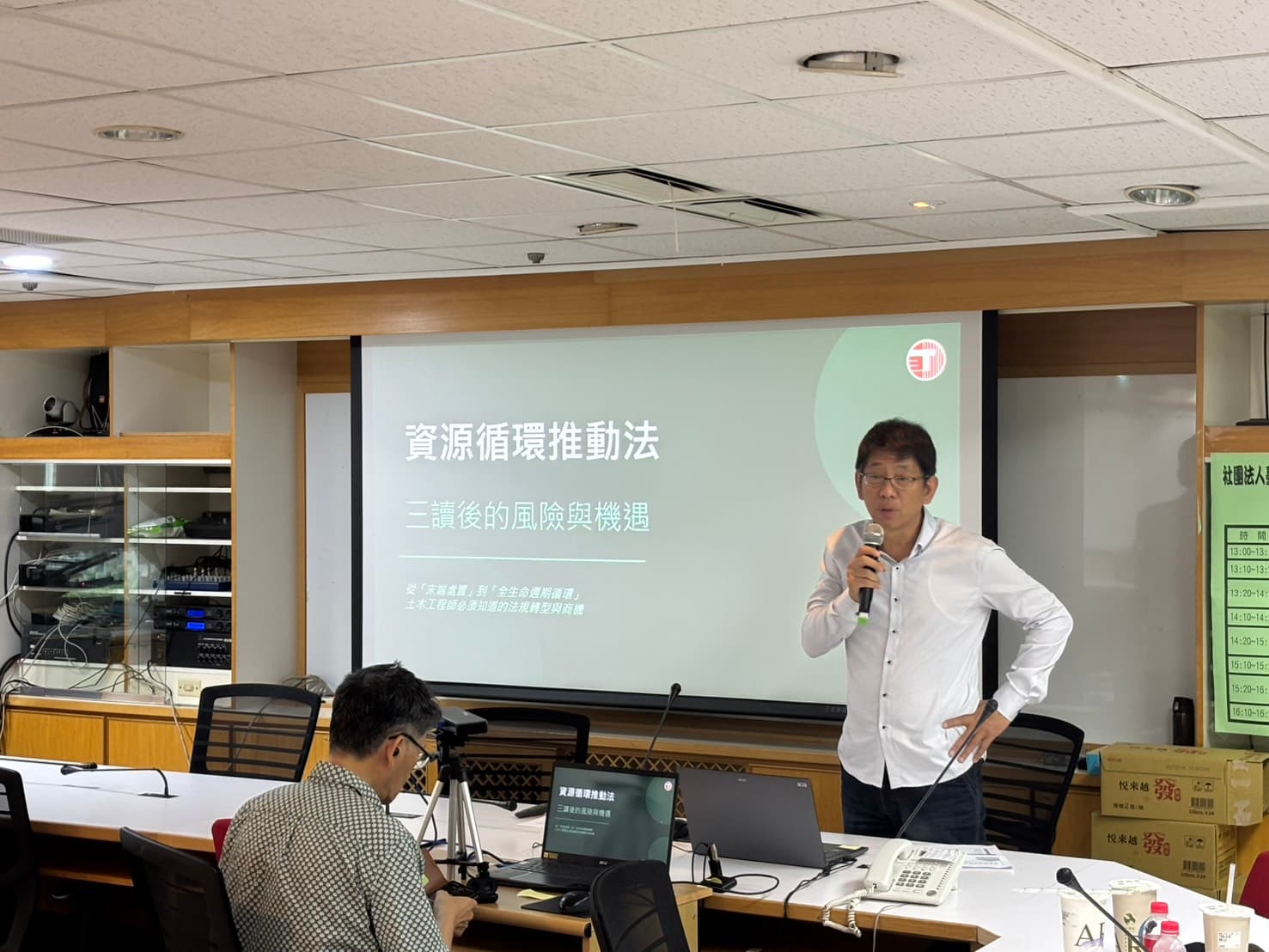
迎戰永續新法規與國際標準:資源循環、淨零工程與 CSRD 研討會 由臺灣永恆學會主辦最新一期永續發展專業研討會,已於日前圓滿落幕。本次活動聚焦於國內外最新永續法規與實務應用,探討了「資源循環推動法」、「淨零碳規劃管理師於工程之應用」以及「歐盟 CSRD 指令影響」等三大前瞻議題。透過工程界與永續領域專家的深度剖析,協助與會者掌握合規風險、發掘綠色商機,進一步
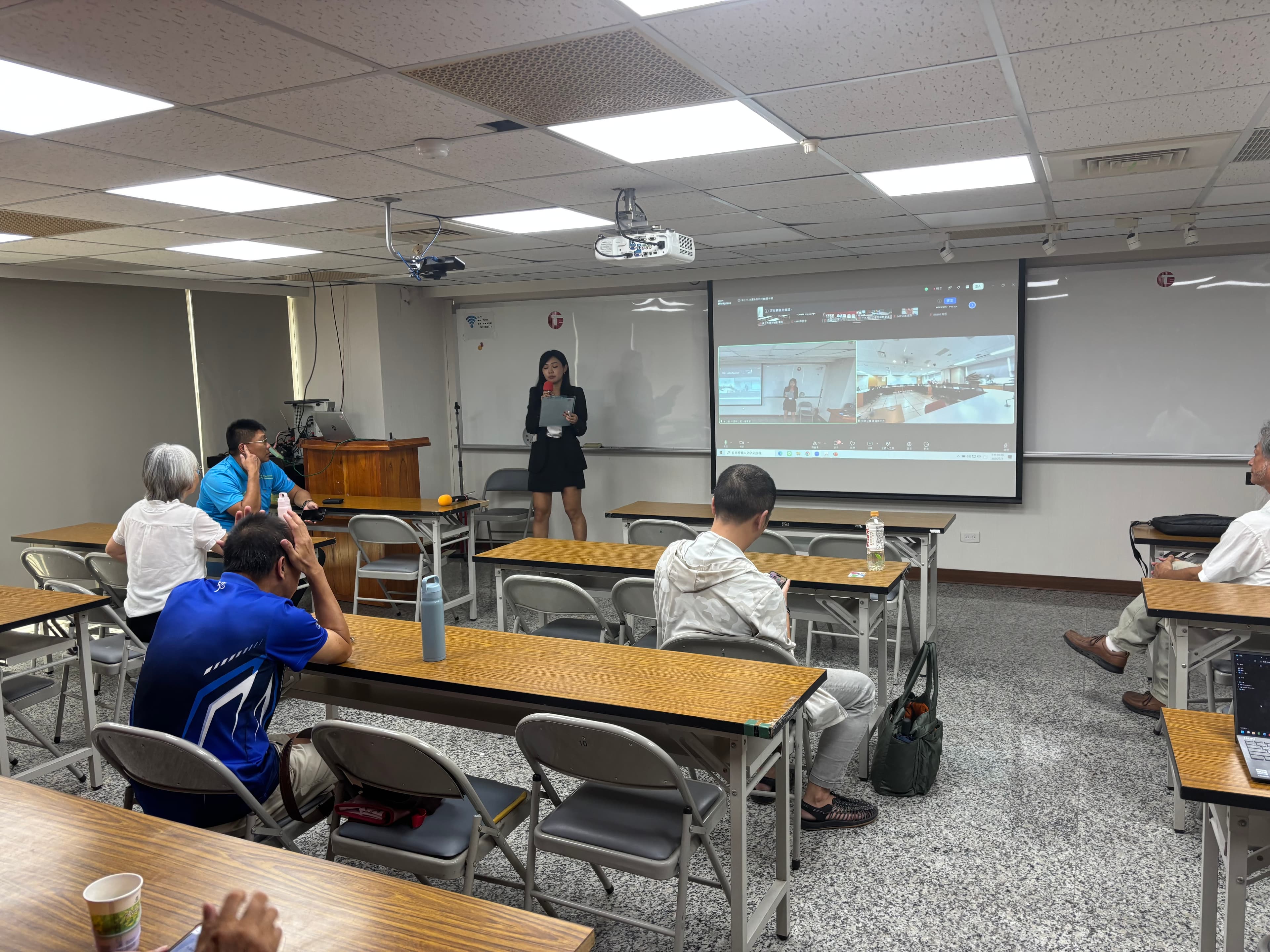
臺灣永恆學會日前圓滿舉辦永續研討會,聚焦資源循環與淨零轉型。會中邀請專家深度探討三大核心議題:成大黃忠信教授分享「淤泥材料資源化」技術;陳致光技師解析「淨零碳規劃管理師」實務應用;最後由陳泰安理事長梳理「永續報告書」法規演進。本次活動成功匯聚工程與永續領域的跨界人才,期盼攜手推動產業低碳轉型,共築臺灣永續未來。
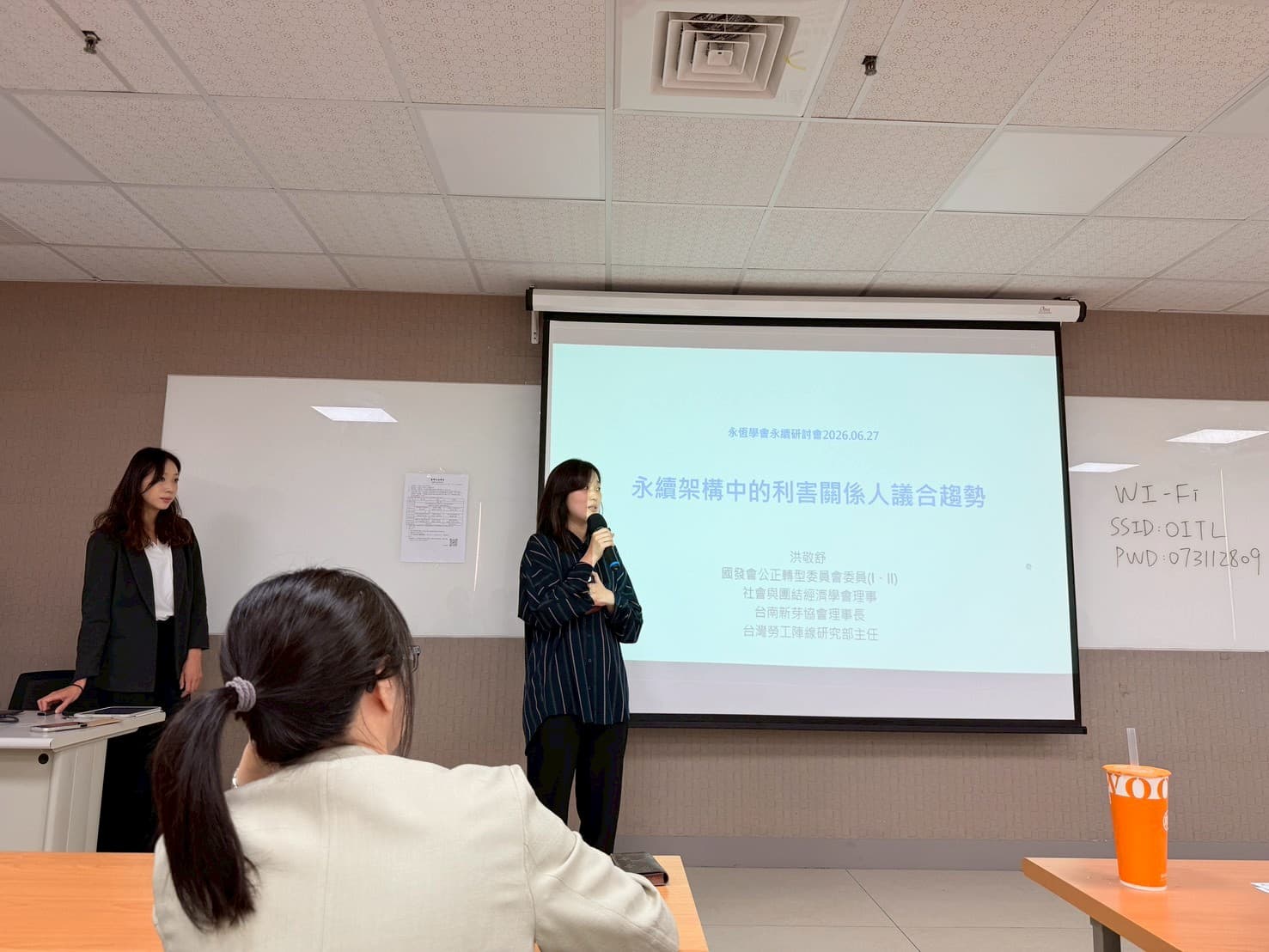
迎接2050淨零碳排,臺灣永恆學會與臺灣省土木技師公會於高雄舉辦「永續研討會」。活動聚焦三大核心:探討公正轉型與利害關係人議合趨勢、解析證照制度下的淨零碳管理人才定位,以及從釋字453號出發,檢視專技人員在永續發展中的法理角色與風險把關。期盼透過產學專家的深度交流,協助工程與永續領域專業人士精準調適服務,掌握綠色競爭力,攜手在氣候變遷的挑戰中,共創淨零未來的嶄新價值。
As climate change pushes sustainable development towards regulation and measurement, the Taiwan Intergenerational Sustainability Society brings together attorneys, accountants, architects, professional engineers, social workers and other state-licensed professionals to advance sustainability education, research and practice, and to build a platform for exchange at home and abroad.
9
Founding professionals20
Founding officers4
Offices nationwide6
Society awardsAs climate change pushes sustainable development towards regulation and measurement, and in order to serve the public more accountably, the Taiwan Intergenerational Sustainability Society was brought into being by nine state-licensed professionals: the professional civil engineers 陳泰安, 莊均緯, 侯佳玟, 連柄順, 吳宗翰, 柯宗滕 and 鄭峯昇, and the attorneys-at-law 鄒純忻 and 林楷傑. The founders' meeting and the first preparatory meeting were held on 11 November 2025, and the Society formally began its work.
The inaugural general meeting was held on 12 December 2025 at No. 311, Section 2, Zhongshan Road, Zhonghe District, New Taipei City, where twenty founding officers were elected. It was chaired by 陳泰安, convener of the preparatory committee, who described the difficulties of the preparatory work and thanked everyone who had helped with it. With the enthusiastic participation of the founding members present, 陳泰安 was elected president and 莊均緯 managing supervisor, to lead the Society as it grows.
On 15 April 2026 the Ministry of the Interior approved the Society's establishment as a civil association, and on 11 May 2026 it was registered with the court under its formal name, the Taiwan Intergenerational Sustainability Society.
15 directors and 5 supervisors, serving unpaid three-year terms.
11 Nov 2025
Founders' meeting and first preparatory meeting held
12 Dec 2025
Inaugural general meeting held in Zhonghe District, New Taipei City; 20 founding officers elected
15 Apr 2026
Approved by the Ministry of the Interior as a civil association
11 May 2026
Registered with the court under its formal name, the Taiwan Intergenerational Sustainability Society
Talks, courses, publications, exhibitions and public advocacy on sustainability.
News of the Society, reports on its activities, and columns by members.
An academic journal of sustainable development and social innovation.
Surveys of sustainability issues in industry, with policy recommendations.
Special issues marking milestones of the Society and its general meetings.
For publication enquiries, write to tachen@disastray.com or call 02-2727-7160.
Anyone who supports the Society's aims may apply. Complete the application form; membership begins once the board of directors has approved it and the fees have been paid.
Amounts in New Taiwan dollars. The joining fee is payable on admission.
Already a member? Sign in to the member area
Recorded by the Ministry of the Interior, April 2026, letter Tai-Nei-Tuan-Zi No. 1150006830
Article 1The name of this association is the Taiwan Intergenerational Sustainability Society (hereinafter "the Society").
Article 2The Society is a non-profit, public-interest social organisation established under the law. Its aims are to advance environmental sustainability and social innovation, to work for the common good, and to make sustainability education widely available.
Article 3The tasks of the Society are as follows, to be pursued and carried out in accordance with the relevant laws and regulations:
Article 4The competent authority for the Society is the Ministry of the Interior. The Society's activities are subject to the guidance and supervision of the authority competent for each activity.
Article 5The organisational area of the Society is the entire national administrative area.
Article 6The Society's office shall be located within the jurisdiction of the competent authority, and branch offices may be established with that authority's approval. The constitution of a branch office under the preceding paragraph takes effect once it has been passed by the general meeting of members (or of member representatives) and approved by the competent authority. The addresses of the office and of any branch office shall be reported to the competent authority for record when they are established and when they change.
Article 7Members of the Society and their fees are classified as follows:
Article 8Members have the right to vote, to elect, to be elected and to recall. Supporting members do not have the rights referred to in the preceding paragraph.
Article 9Directors and supervisors of the Society serve a term of three years.
Article 10The Society has fifteen directors, including five managing directors, of whom one is the president and two are vice-presidents, and two alternate directors. The managing directors are elected by the directors from among themselves, and the president is elected by the directors from among the managing directors. The vice-presidents are appointed by the president from among the managing directors.
Article 11The Society has five supervisors, one of whom is the managing supervisor, and one alternate supervisor. The managing supervisor is elected by the supervisors from among themselves, oversees the day-to-day affairs of the Society, and chairs the board of supervisors.
Article 12Members are obliged to observe this charter and the resolutions of the Society and to pay their fees. A member who has not paid is not entitled to exercise the rights of membership; a member who has not paid for two consecutive years is deemed to have resigned. A member who has been removed, has resigned or has been suspended and who wishes to be reinstated shall first clear any fees owed, unless the board of directors approves otherwise for good reason.
Article 13Where a member (or member representative) breaks the law or this charter, or fails to observe a resolution of the general meeting, the board of directors may resolve to issue a warning or to suspend that member's rights. Where the harm to the Society is serious, the general meeting may resolve to expel the member.
Article 14A member ceases to be a member in any of the following circumstances:
Article 15A member may resign by giving the Society written notice stating the reasons.
Article 16The general meeting of members is the supreme authority of the Society. Where there are more than 300 members, member representatives may be elected by district in proportion to numbers and meet together as the assembly of member representatives, exercising the powers of the general meeting. Member representatives serve the same term as directors and supervisors; their number and the rules for electing them take effect once passed by the board of directors, and shall be reported to the competent authority for record.
Article 17The powers of the general meeting are as follows:
The scope of the major matters referred to in subparagraph 8 of the preceding paragraph is determined by the board of directors.
Article 18Directors and supervisors are elected by the members (or member representatives) and form the board of directors and the board of supervisors respectively. When they are elected, alternate directors and alternate supervisors may be elected at the same time according to the count, and they fill vacancies among the directors and supervisors in order. The board of directors may propose a reference list of candidates for the next term. Directors and supervisors may be elected by remote ballot; the rules for such a ballot take effect once passed by the board of directors, and shall be reported to the competent authority for record.
Article 19The president directs and supervises the affairs of the Society internally, represents it externally, and chairs the general meeting and the board of directors. If the president is unable to act, they shall appoint one of the vice-presidents to act in their place; if no appointment is made or can be made, the managing directors shall choose one of their number to act. A vacancy in the office of president or of managing director shall be filled by by-election within one month.
Article 20The powers of the board of directors are as follows:
Article 21If the managing supervisor is unable to act, they shall appoint one of the supervisors to act in their place; if no appointment is made or can be made, the supervisors shall choose one of their number to act. A vacancy in the office of chair of the board of supervisors (the managing supervisor) shall be filled by by-election within one month.
Article 22The powers of the board of supervisors are as follows:
Article 23Directors and supervisors serve without remuneration and may be re-elected, but only once. Their term runs from the date of the first meeting of the board of directors of that term.
Article 24A director or supervisor shall be removed from office in any of the following circumstances:
Article 25The Society has one secretary-general, who shall be a member of the Society and serves without remuneration, handling the Society's affairs under the direction of the president; the post may be held concurrently by a director or supervisor. Other staff are appointed and dismissed with the approval of the board of directors. Their responsibilities and the division of duties between levels are laid down separately by the board of directors.
Article 26The Society may establish committees, working groups and other internal bodies. The constitution of each takes effect once passed by the board of directors, as does any amendment to it.
Article 28General meetings of members (or of member representatives) are of two kinds, regular and extraordinary, and are convened by the president. Except for an extraordinary meeting called in an emergency, notice shall be given to all those entitled to attend fifteen days in advance. A regular meeting is held once a year. An extraordinary meeting is held when the board of directors considers it necessary, at the request of one fifth or more of the members (or member representatives), or when the board of supervisors requests it in writing. After the Society has been registered as a juridical person, an extraordinary meeting is held at the request of one tenth or more of the members (or member representatives). A general meeting may be convened by video conference or by any other means announced by the central competent authority, with attendance and voting conducted using the corresponding electronic facilities. Matters of election, by-election and recall shall, however, be dealt with at a meeting held in person.
Article 29A member (or member representative) unable to attend a general meeting in person may appoint another member (or member representative) as proxy in writing. No member (or member representative) may act as proxy for more than one other.
Article 30A resolution of the general meeting requires the attendance of more than half of the members (or member representatives) and the consent of more than half, or of the greater number, of those attending. Resolutions on the following matters, however, require the consent of two thirds or more of those attending:
After the Society has been registered as a juridical person, an amendment to the charter requires the consent of three quarters or more of those attending, or the written consent of two thirds or more of all members; the Society may be dissolved at any time by the affirmative vote of two thirds or more of all members.
Article 31The board of directors and the board of supervisors each meet at least once every six months, and may hold joint or extraordinary meetings when necessary. Except for an extraordinary meeting, notice of such a meeting shall be given to all those entitled to attend seven days in advance. A resolution requires the attendance of more than half of the directors or of the supervisors respectively, and the consent of the greater number of those attending.
Article 32Directors shall attend meetings of the board of directors, and supervisors meetings of the board of supervisors; attendance by proxy is not permitted at either. Meetings of the board of directors, of the board of supervisors, and joint meetings of the two, may be convened by video conference or by any other means announced by the central competent authority, with attendance and voting conducted using the corresponding electronic facilities. Matters of election, by-election and recall shall, however, be dealt with at a meeting held in person. A director or supervisor who is absent without reason from two consecutive meetings is deemed to have resigned.
Article 33The Society's funds come from the following sources:
Article 34The Society's financial year follows the calendar year, running from 1 January to 31 December. Before the start of each financial year the board of directors draws up the annual work plan and the budget of income and expenditure; within three months of the end of the year it draws up the work report and the accounts for the preceding year. These are sent to the board of supervisors, which audits them and returns them to the board of directors with a written opinion. Together with the work plan and budget for the current year, they are then submitted to the general meeting for approval and reported to the competent authority for record. If the general meeting cannot be held as scheduled, the documents may first be passed by the board of directors, the board of supervisors or a joint meeting of the two, submitted to the general meeting for ratification afterwards, and then reported to the competent authority for record.
Article 35On dissolution, the Society's remaining assets pass to the local self-governing body of the place where it is situated, or to a body designated by the competent authority. If the Society has been registered as a juridical person, the appointment of liquidators and the liquidation of its assets follow the Civil Code, unless the law provides otherwise; if it has not been so registered, they follow a resolution of the general meeting, and where the general meeting cannot resolve the matter the president acts as liquidator, the provisions of the Civil Code on liquidation applying mutatis mutandis.
Article 36Matters not provided for in this charter are governed by the relevant laws and regulations.
Article 37This charter takes effect once passed by the general meeting of members (or of member representatives) and reported to the competent authority for record, as does any amendment to it.
Article 38Adopted at the first general meeting of the first term, held on 12 December 2025.
Adopted at the first general meeting of the first term, held on 12 December 2025.
Please get in touch with any question about the Society's affairs, its courses, or your rights as a member.